
Insurance and Safety for Industrial Driveway Cleaning
Insured gardening company operators delivering industrial driveway cleaning and commercial driveway maintenance carry a responsibility that goes beyond sparkling surfaces. Whether the task is heavy-duty industrial concrete cleaning or ongoing industrial driveway maintenance, our approach prioritises health, liability protection and procedural safety. This page explains how an insured gardening business manages public liability insurance, staff training, personal protective equipment and a rigorous risk assessment process to keep sites safe, compliant and efficient.
Public Liability Insurance: Why It Matters
Public liability cover is the backbone of any professional industrial driveway cleaning service. An insured gardening company will hold adequate public liability insurance to protect clients, staff and third parties from accidental damage or injury during driveway pressure washing, chemical cleaning or mechanical sweeping.
Public liability is not optional — it demonstrates financial responsibility and gives clients confidence that any unforeseen incidents will be handled promptly and fairly.

Scope and Verification of Coverage
Before any commercial driveway cleaning job commences, proof of insurance is verified. Coverage typically includes accidental property damage, bodily injury to visitors or passers-by, and legal costs arising from claims. An insured gardening company will also maintain employer's liability insurance to protect staff, and where specialist chemicals or plant are used, additional product or plant insurance is often in place. Key policy details include:
- Indemnity limits sufficient for industrial sites and heavy machinery
- Coverage for subcontractors and hired plant
- Public and employer's liability certificates available on request
Comprehensive Staff Training and Competency
Qualified personnel are essential for safe industrial driveway cleaning. Staff training encompasses operational training for pressure washers and rotary scrubbing machines, safe chemical handling, manual handling techniques and traffic management for commercial driveways. An insured gardening company invests in continuous professional development so teams remain competent with evolving equipment and environmental regulations.

Training Programs and Certification
Training is both theoretical and practical. New operatives receive site induction and shadow experienced crews before independent work.
Competency records are retained for each employee and include:
- Formal training certificates for pressure washing and powered equipment
- COSHH (Control of Substances Hazardous to Health) awareness for cleaning chemicals
- First aid and emergency response training specific to outdoor operations
Personal Protective Equipment (PPE)
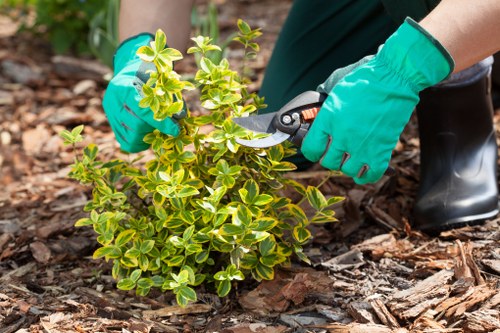
Providing and enforcing correct PPE use reduces risk and demonstrates a commitment to safety. All operatives on an industrial driveway cleaning project are supplied with and required to use approved PPE.
This is non-negotiable for tasks involving high-pressure water, detergents or mechanical plant.
- Waterproof, chemical-resistant gloves and aprons
- High-visibility jackets and protective footwear with puncture-resistant soles
- Face shields, safety goggles and hearing protection for equipment operation
- Respiratory protection where aerosolised chemicals or dust are present
Risk Assessment Process: Systematic and Site-Specific
The risk assessment is the cornerstone of safe industrial driveway cleaning. Each job receives a site-specific assessment that identifies hazards, evaluates risks, and records control measures.
Risk assessments are documented, communicated to staff, and reviewed regularly, especially when conditions change.

Step-by-Step Risk Assessment
A typical risk assessment process for industrial concrete cleaning includes:
- Site reconnaissance to map hazards such as traffic flow, pedestrian routes, and nearby plant
- Identification of hazardous substances and assessment under COSHH
- Evaluation of environmental risks: drainage, run-off control and protected areas
- Specification of control measures: exclusion zones, signage, traffic marshals and PPE
- Emergency planning and communication protocols
Controls, Monitoring and Record-Keeping
Controls are practical and measurable. They include physical barriers, clear signage, timed operations to avoid peak hours, and the use of biodegradable detergents where needed. An insured gardening company maintains detailed records of assessments, training logs, maintenance checks for pressure units, and insurance documents. These records support compliance and enable quick response if an incident occurs.
Operational Safety and Environmental Considerations
Operational safety covers equipment maintenance, spill response, and environmental controls. Routine plant inspections ensure pressure washers and vacuum recovery systems operate safely. Where wastewater management is required for commercial driveway cleaning, containment and lawful disposal procedures are followed to protect drains and local wildlife.
Environmental stewardship forms part of a responsible industrial driveway cleaning policy.
Final Assurance from an Insured Gardening Company
Choosing an insured gardening firm for industrial driveway cleaning or commercial driveway maintenance means selecting a provider that pairs professional insurance cover with rigorous safety systems. From verified public liability insurance and continual staff training to enforced PPE protocols and a thorough risk assessment process, the focus remains on prevention, protection and compliance.
Safety is integral to every job — not an afterthought.